

Beyond the basics
Exploring gravitational waves
from strong phase transitions
David J. Weir [they/he]
-
University of Helsinki
davidjamesweir@mementomori.social
This talk: saoghal.net/slides/tallinn2026
3rd Nordic Cosmology Meeting, 24 September 2026
What happened in the early universe? before recombination? in dark sectors?
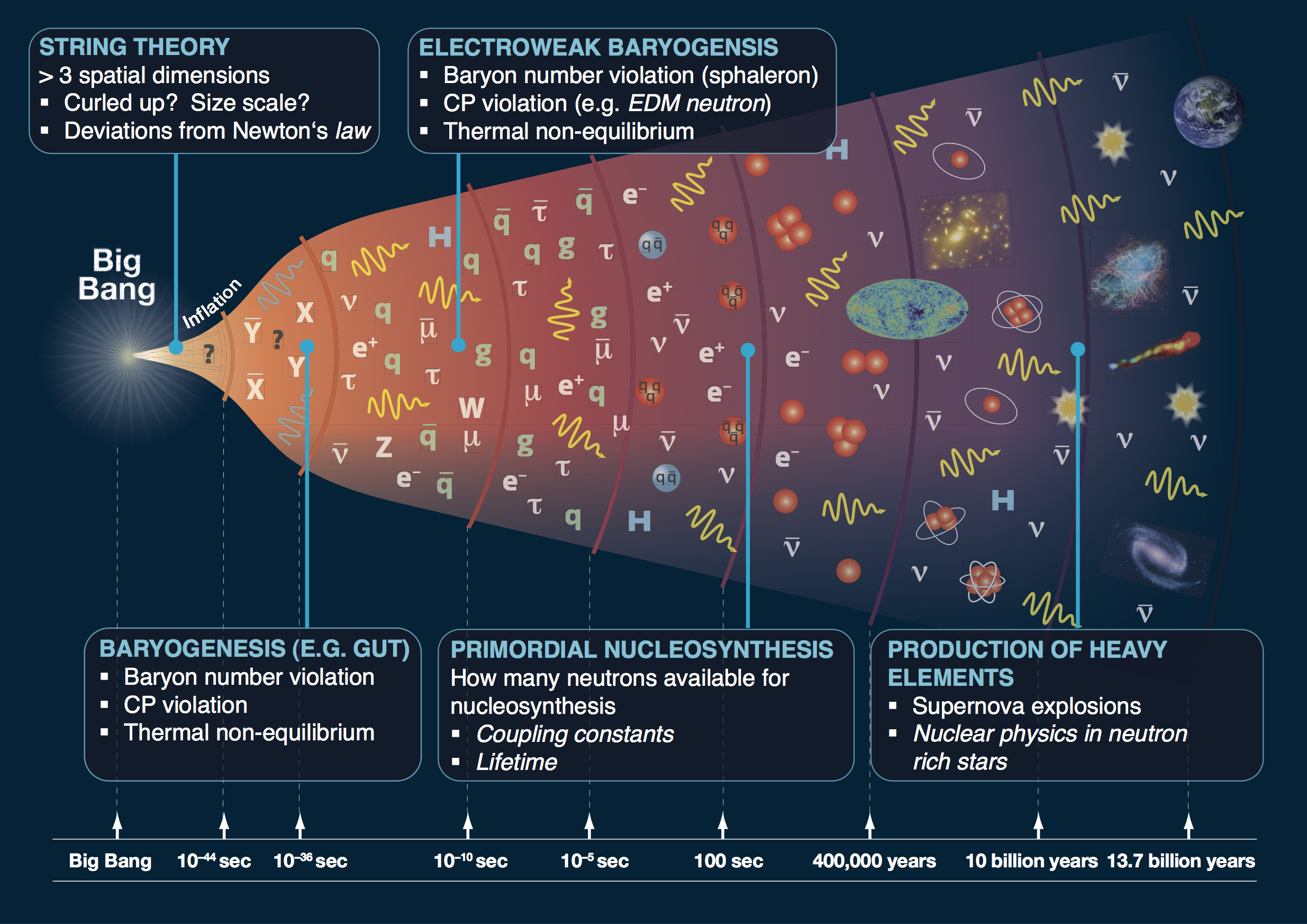
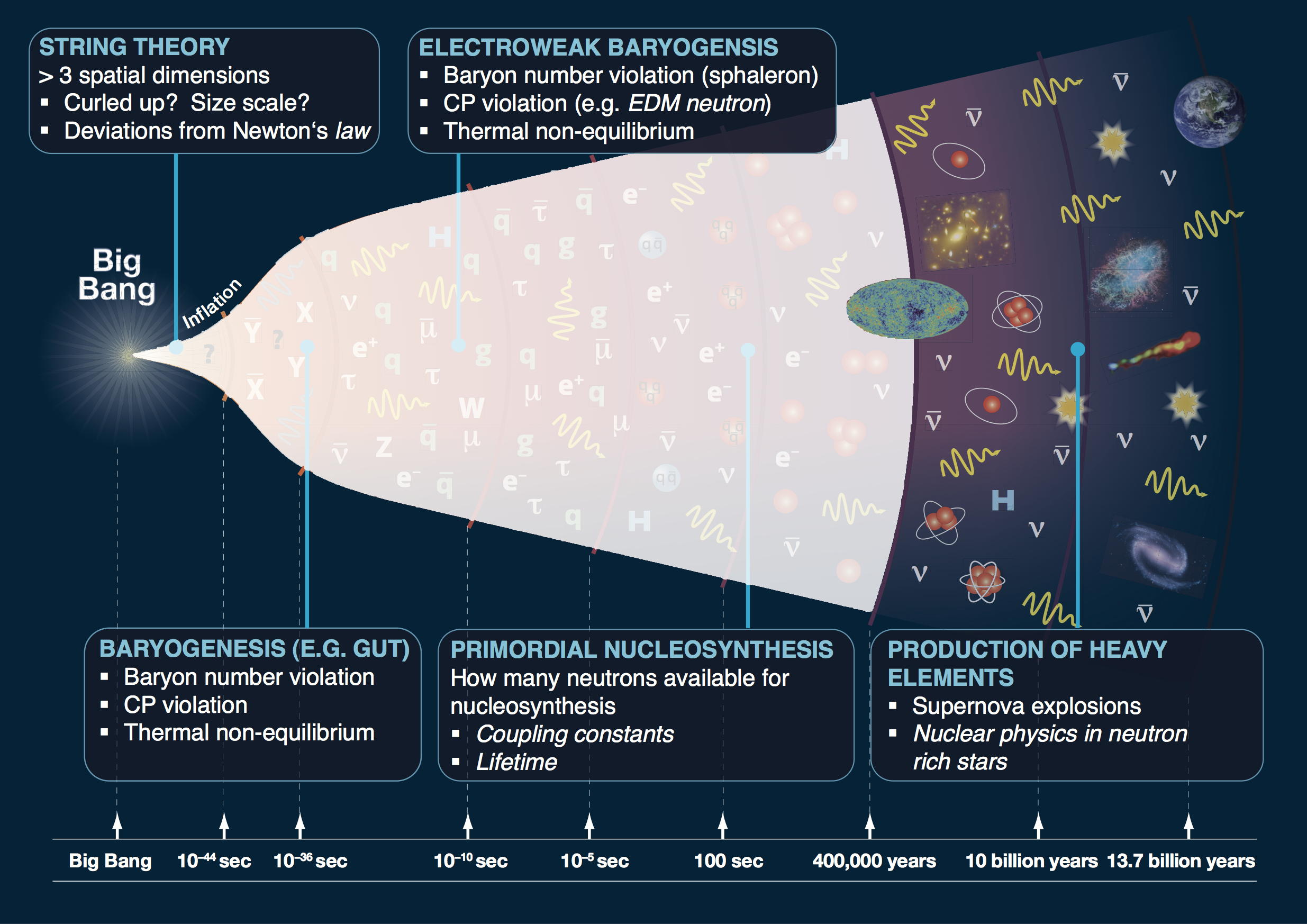
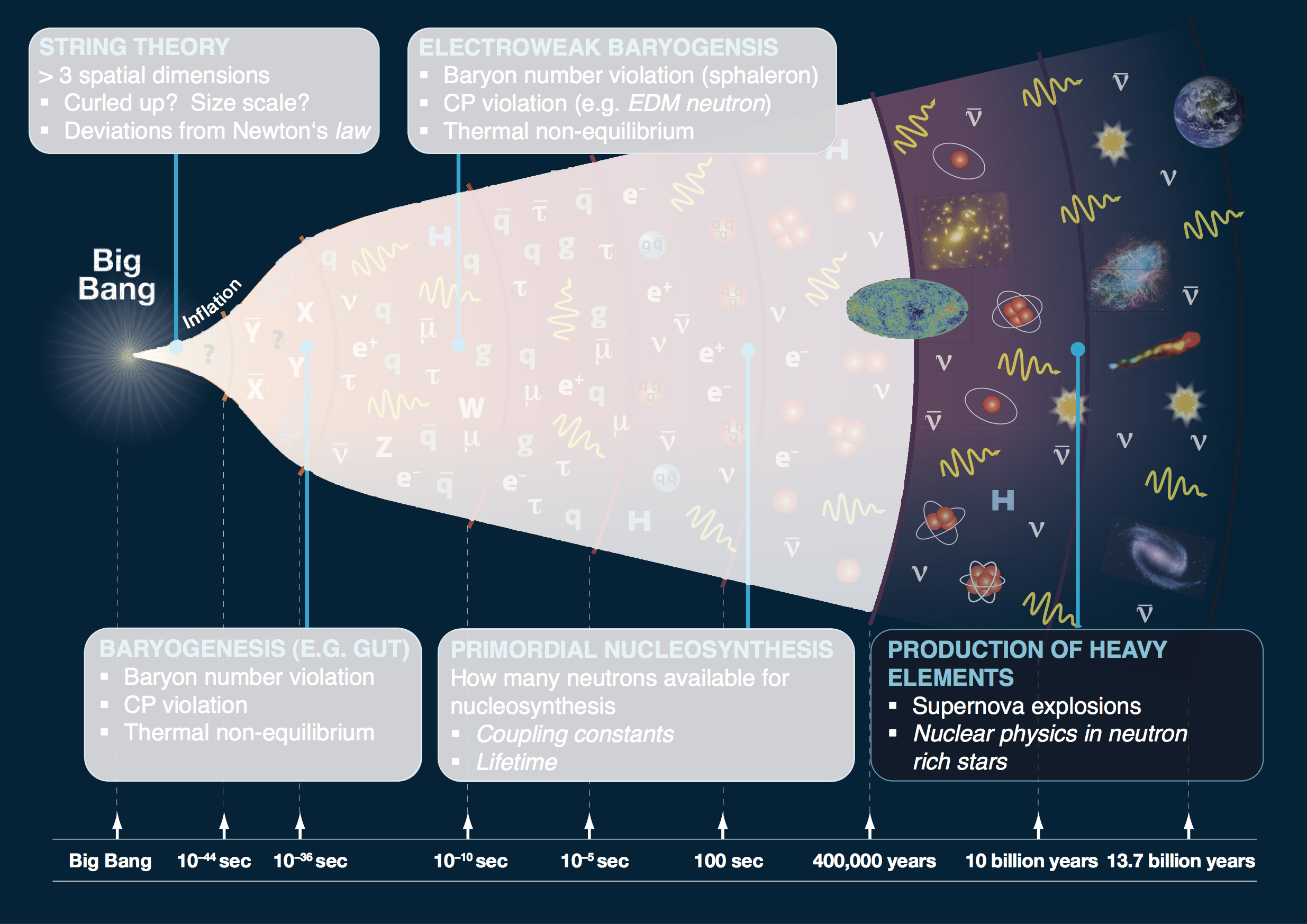
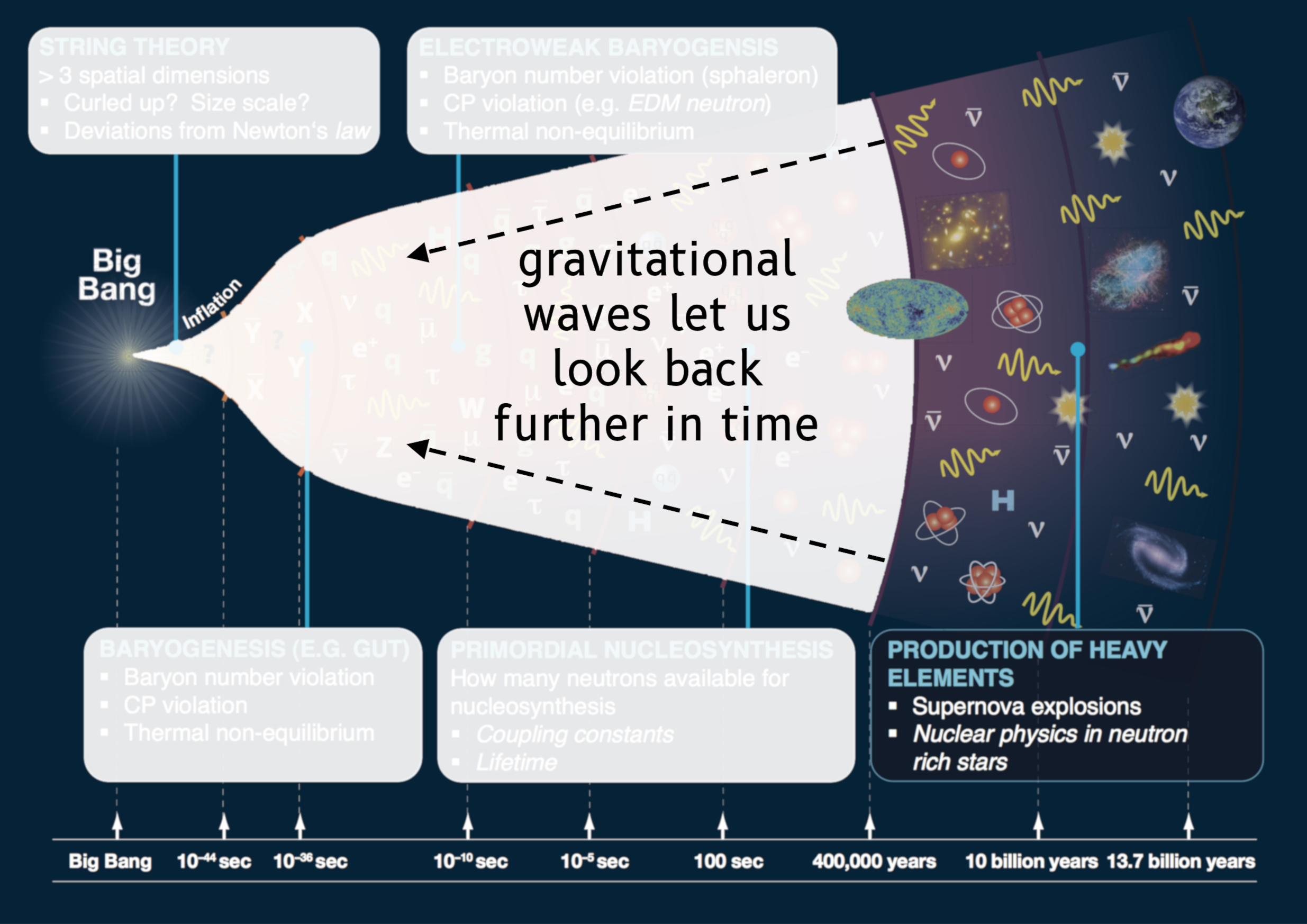
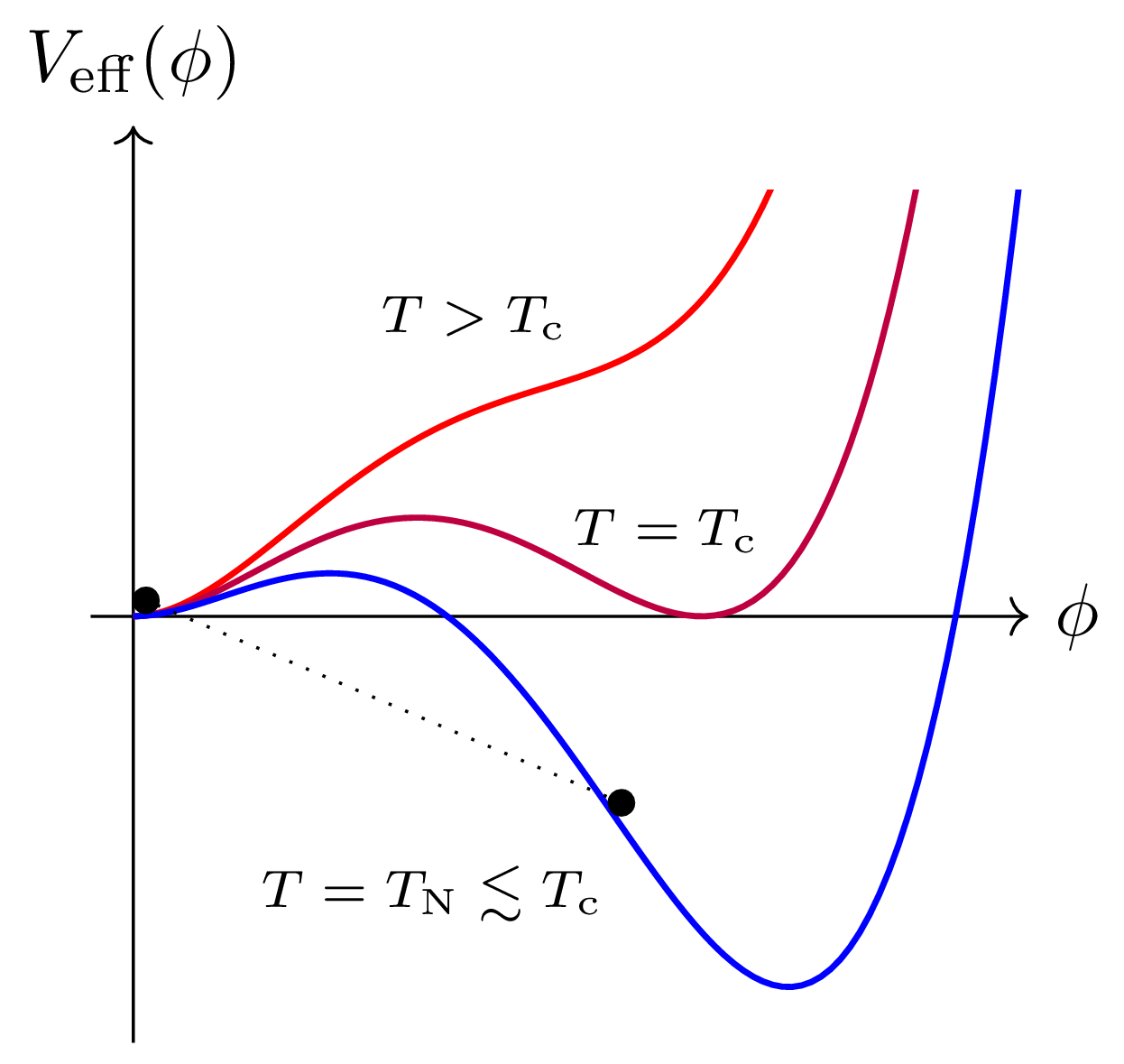
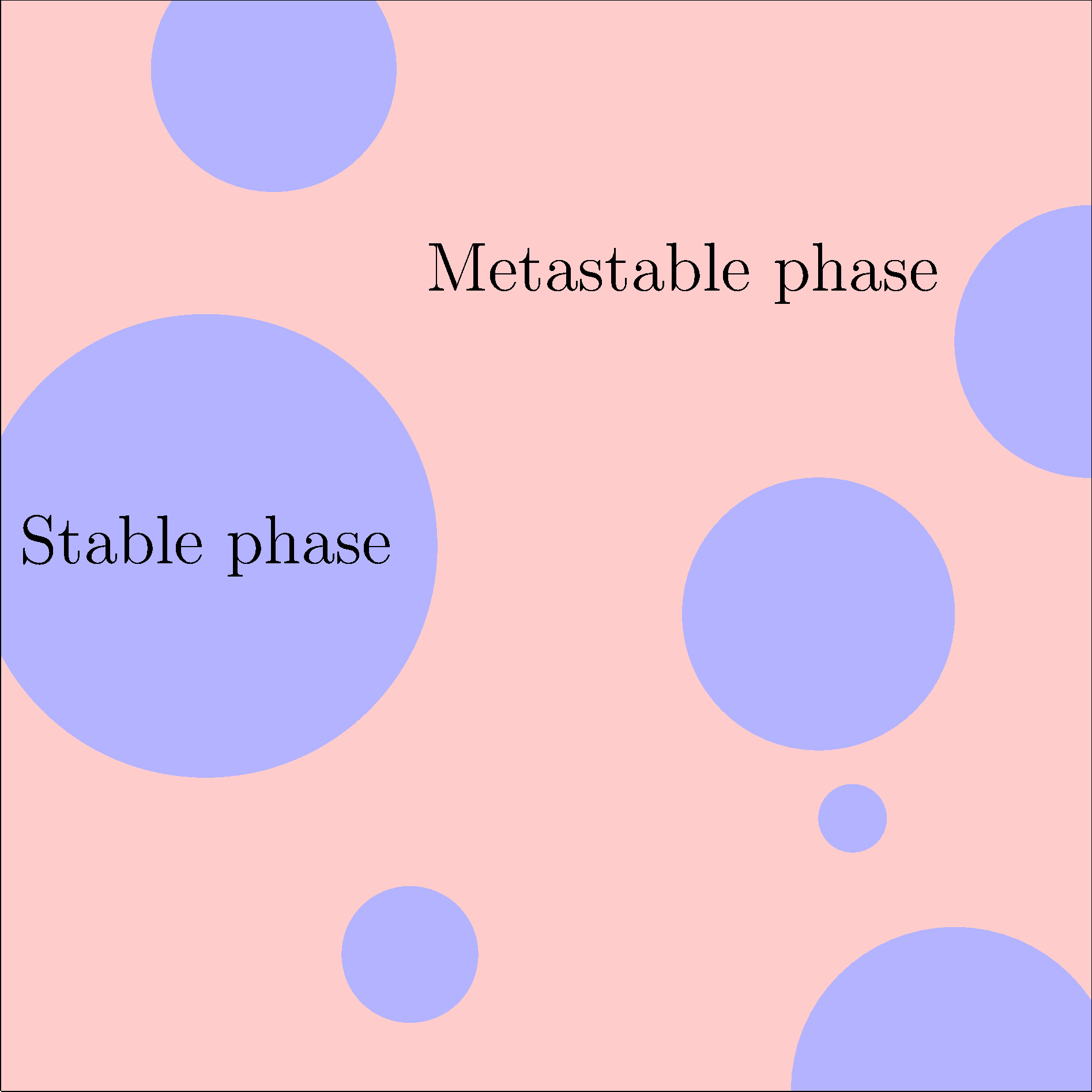
First order phase transition
- High temperatures: potential has one global minimum
- Below $T_\mathrm{c}$, second minimum becomes global minimum
- Nucleation temp. $T_\mathrm{n}$: ~ 1 bubble per causal volume
- 'Percolation' temp. $T_\mathrm{p}$: broken phase clusters join up
Summary: what happens?
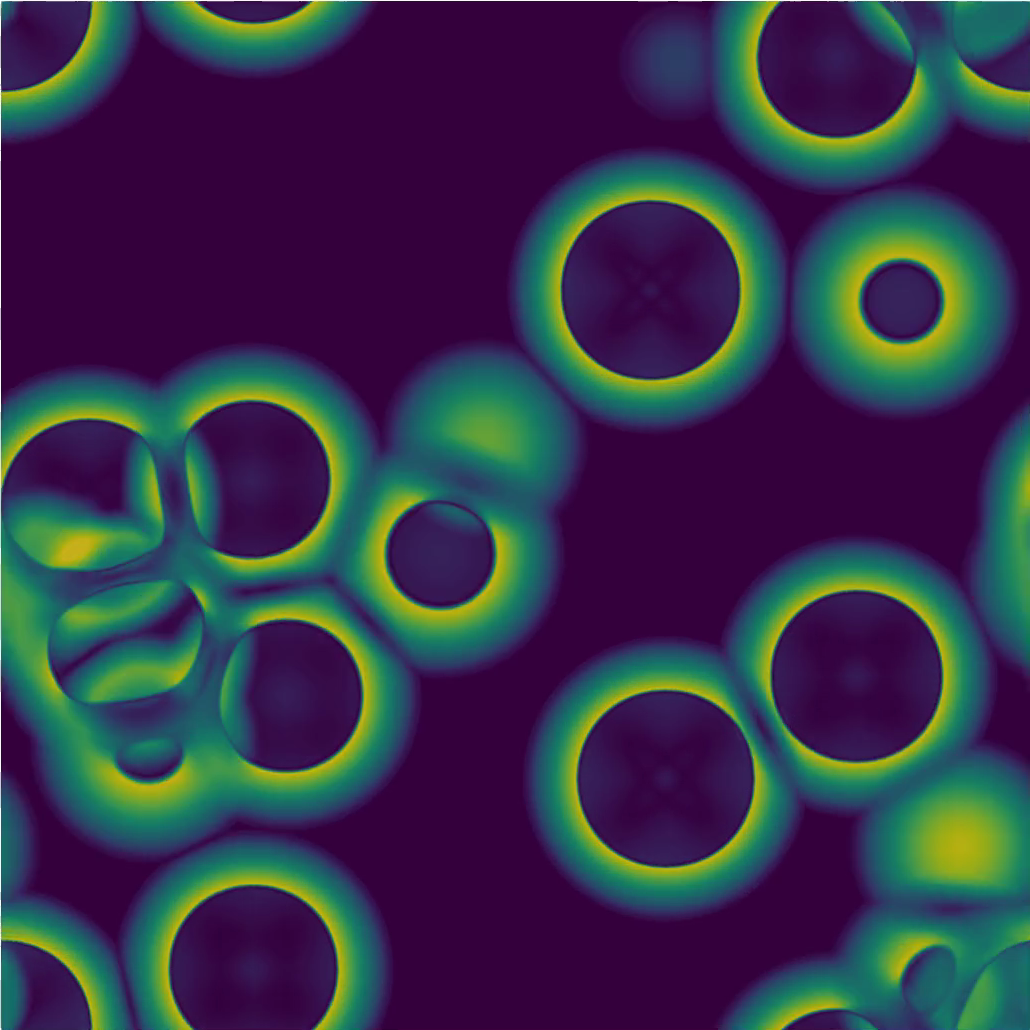
- Nucleation (temperatures $T_\mathrm{n}$→$T_\mathrm{p}$, duration $\beta^{-1}$)
- Bubble walls expand in a plasma (at velocity $v_\mathrm{w}$)
- Reaction fronts form around walls (with strength $\alpha$)
Then what?
- Bubbles (size $R_*$) + fronts collide GWs
- Sound waves left behind, plasma 4-velocity $U$ GWs
- System becomes 'turbulent'; KE starts to decay GWs
- GW production saturates; Hubble damping
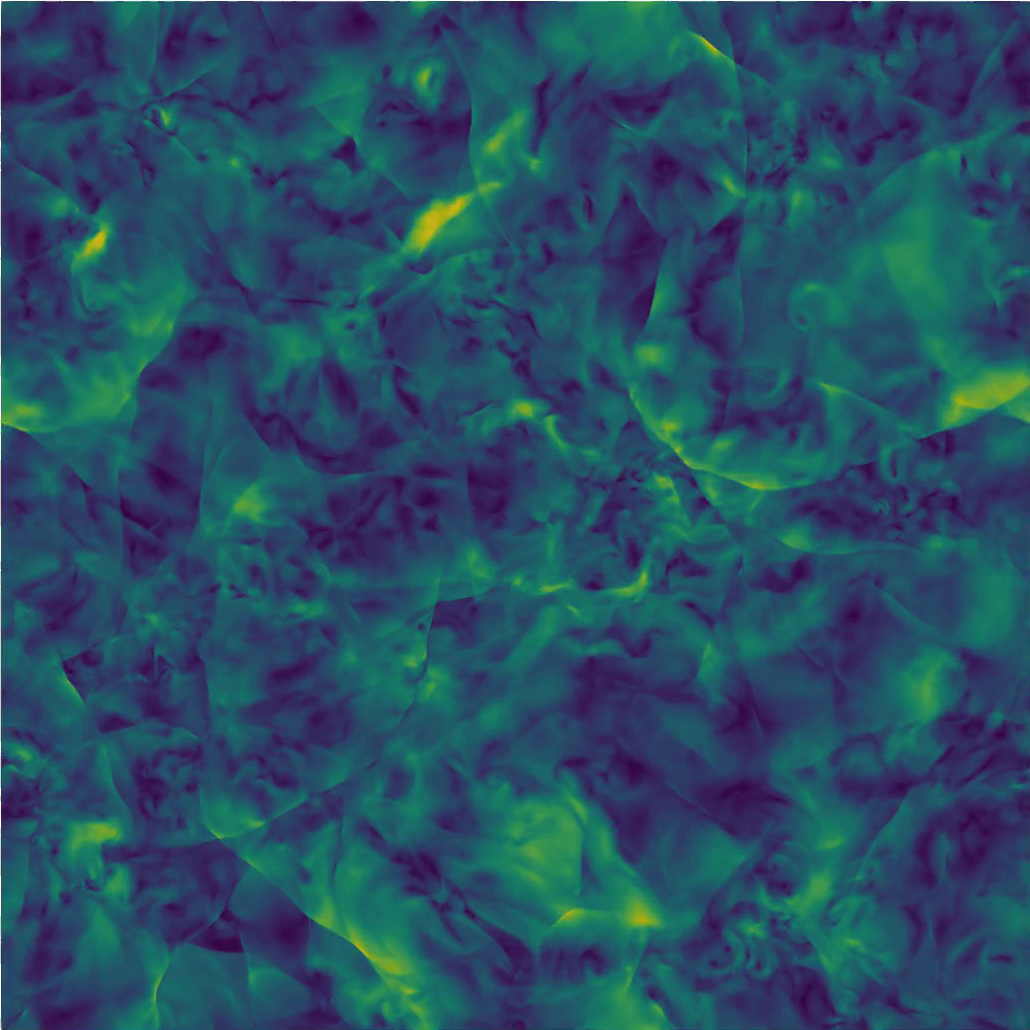
What is a strong phase transition?
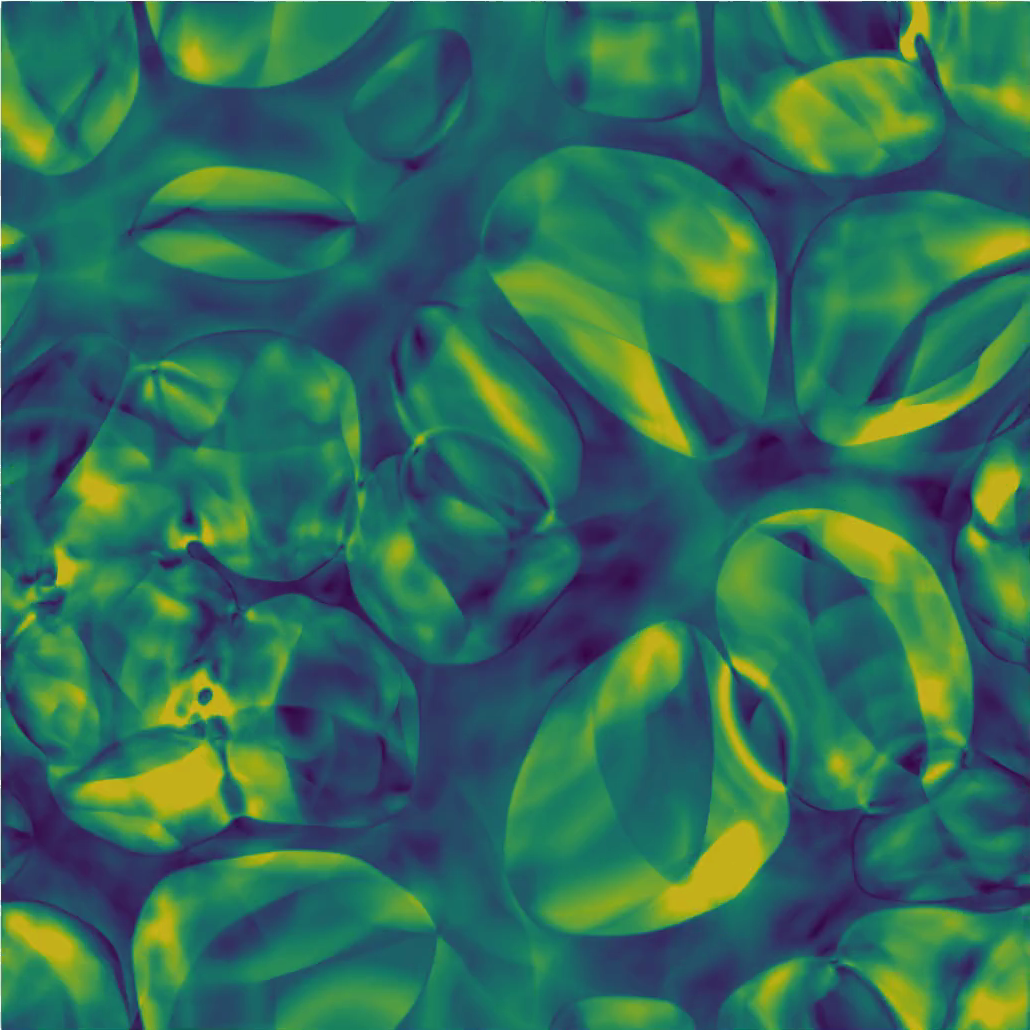
- Plasma velocities become relativistic
⇒ flows quickly become nonlinear - Nonlinearities include:
- shocks ➠ acoustic turbulence $t_{\mathrm{sh}} \sim R_* / U_{\parallel}$
- vortices ➠ [vortical] turbulence $t_{\mathrm{ed}} \sim R_* / U_{\perp}$
- Transport of energy to small scales ⇒ KE decay
- Typically strong means $\alpha$ 'large'
(maybe better to focus on what the flows look like)
Strong simulation example
GWs from phase transitions
- Sound shell model: velocity field is superposition of self-similar sound shells
- Convolve velocity field to get GW power spectrum
- Works for weak transitions, linear flows, small bubble sizes
- Simulations of scalar field $\phi$ and fluid $u^\mu$,
e.g. our SCOTTS code, 'Higgsless' code- Can directly source metric perturbations... $$\ddot{h}_{ij} - \nabla^2 h_{ij} = 16 \pi G T_{ij}^\text{TT}; \qquad T_{ij}^\text{(f)} = w u_i u_j $$
- ...or convolve velocity field $u_i$ as above
Strong phase transition comparisons
Instantaneous GW production rate: arXiv:2505.17824
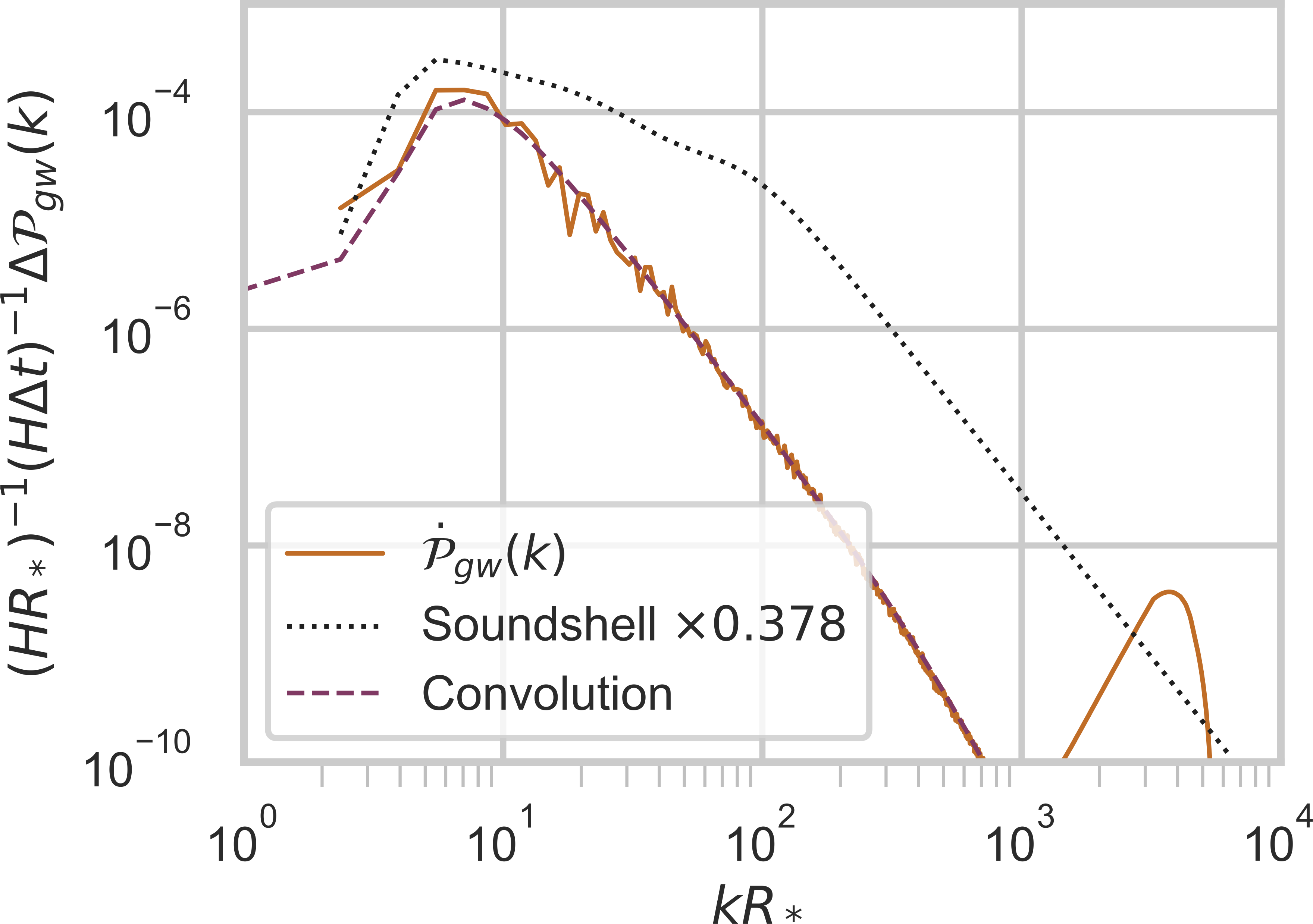
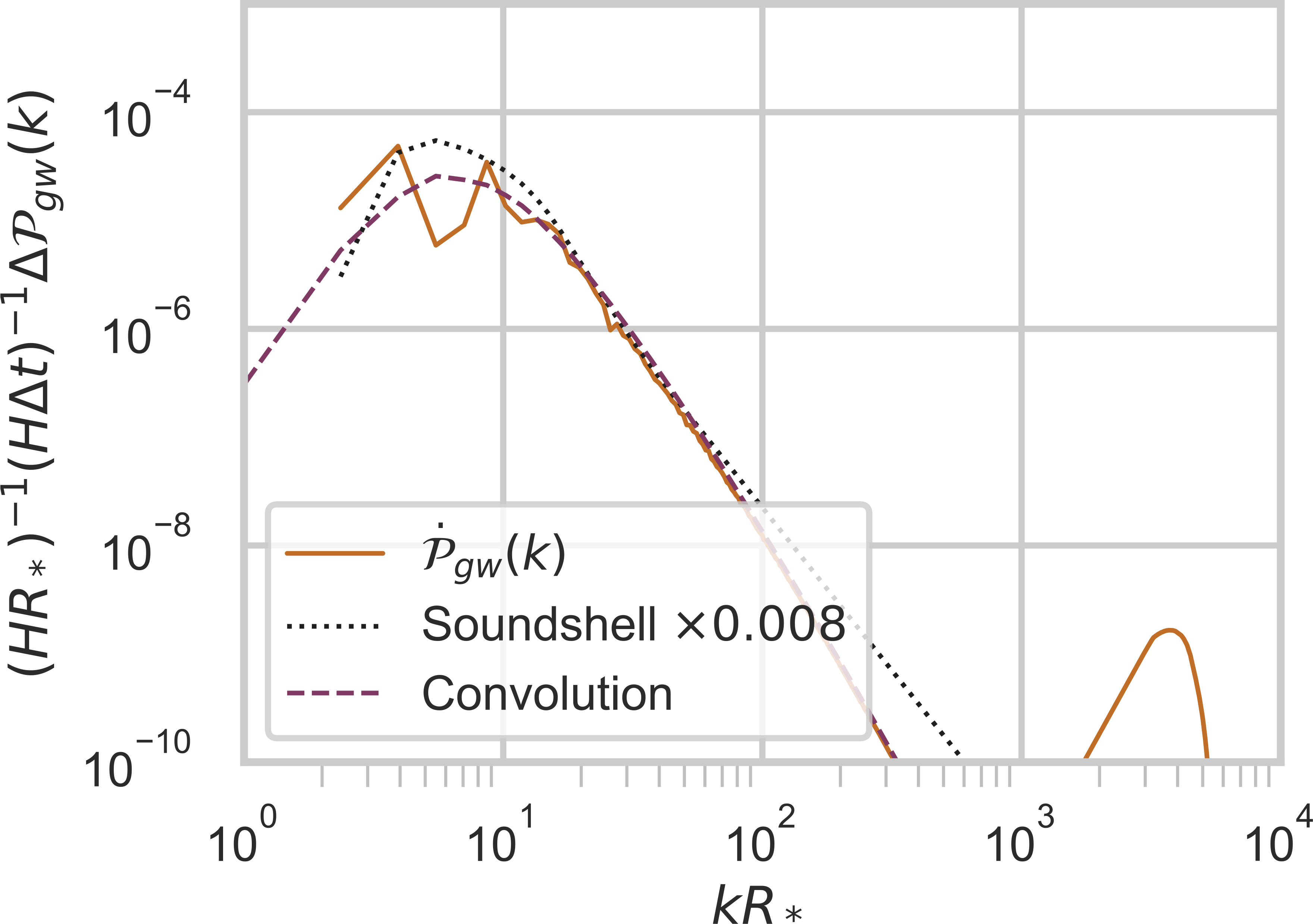
- Sound shell model overestimates, gets wrong shape
- Convolving fluid velocity power spectrum is better
Fluid velocity power $\mathcal{P}_U$
Separated into $\mathcal{P}_{U_\parallel}$ and $\mathcal{P}_{U_\perp}$ (enthalpy-weighted $u^\mu$)
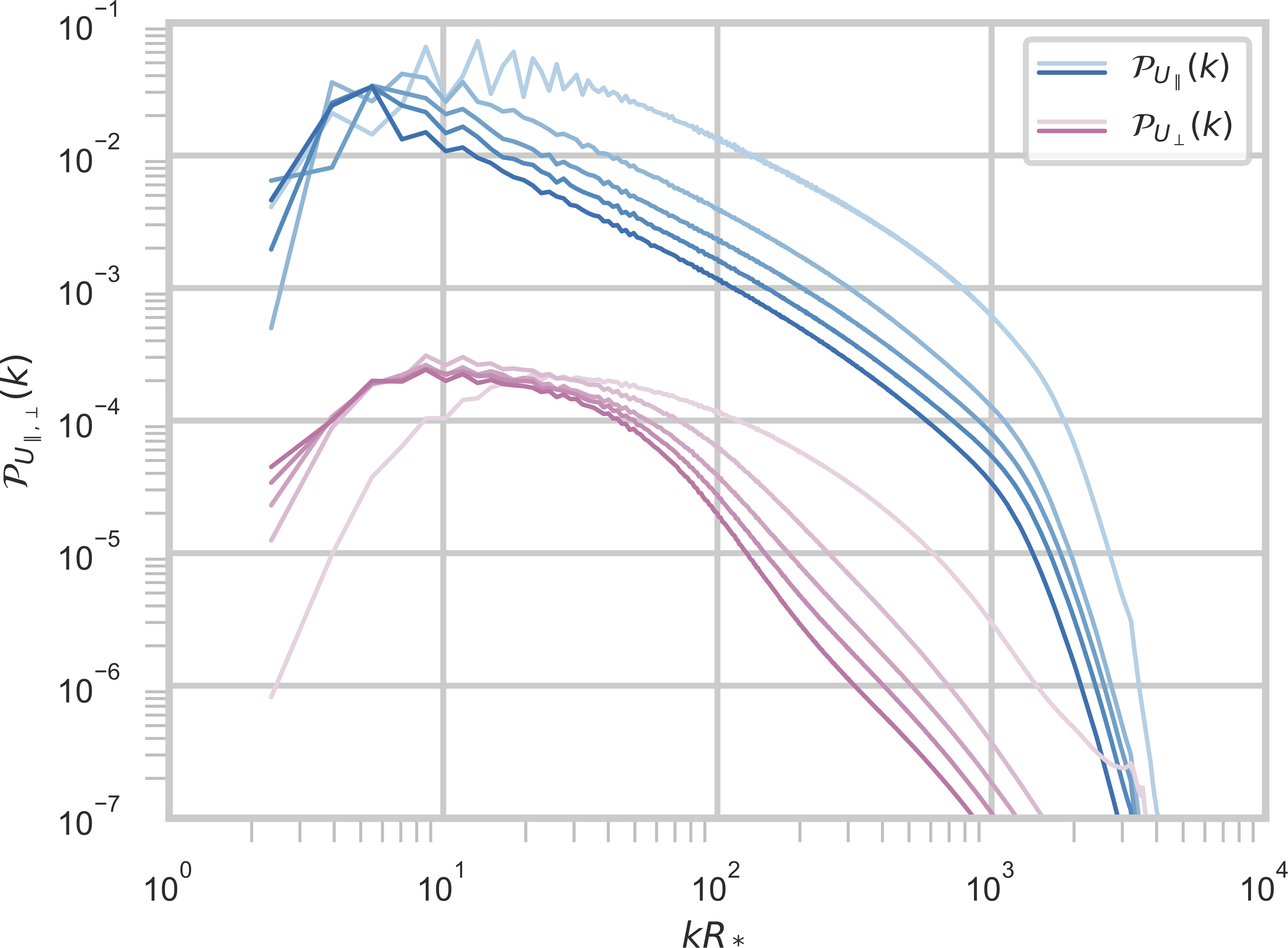 Vortical $\ll$ compressional
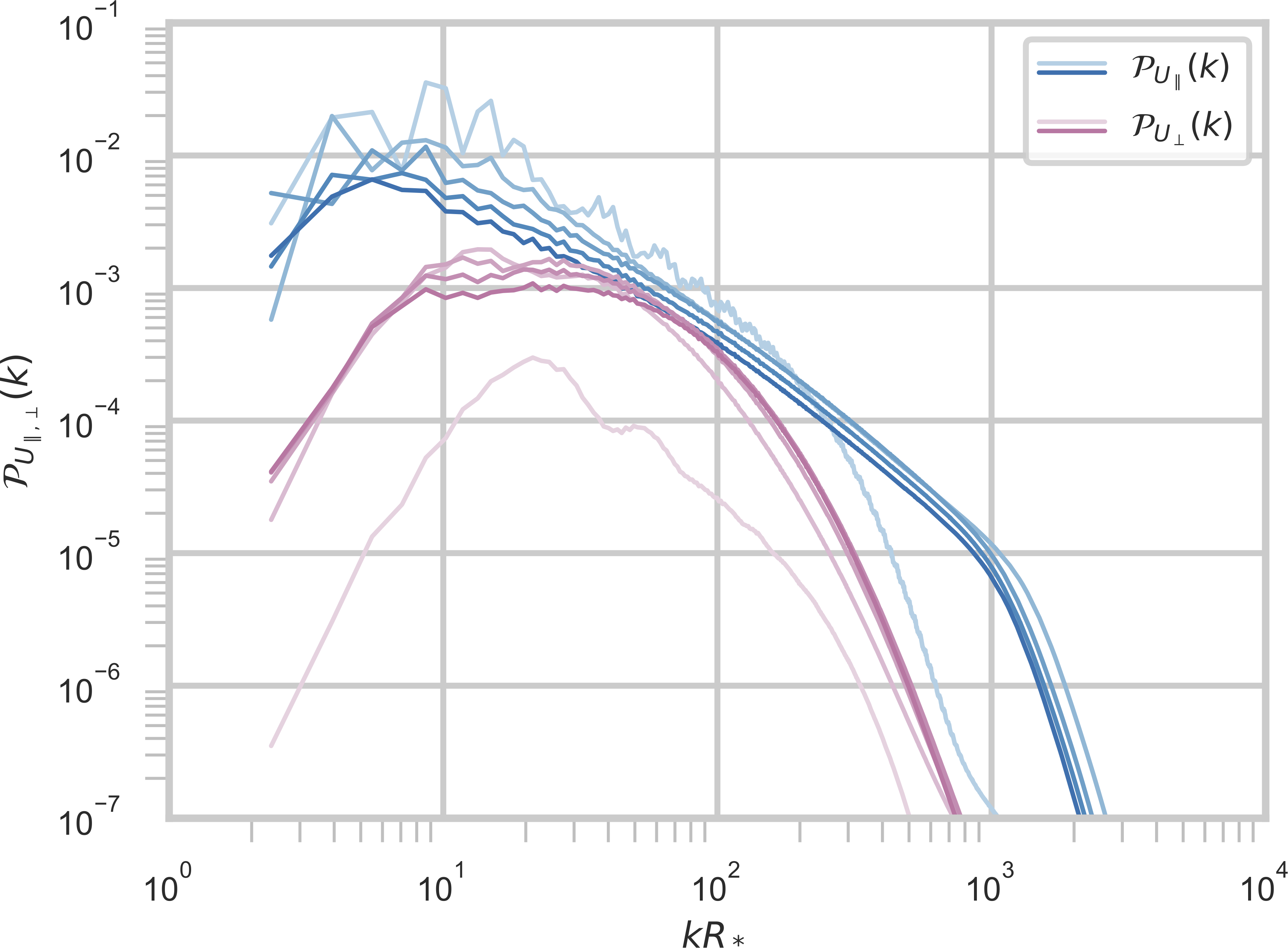 Vortical $\sim$ compressional for some $k R_*$
⬇︎
⬇︎
KE decay
⬇︎
⬇︎
KE decay
Kinetic energy decay
$U_\parallel = U_\parallel^\text{max}\left[1 + \Delta t/t_*\right]^{-\zeta/2}$; the prediction is $\zeta \approx 10/7$ from 2407.05826
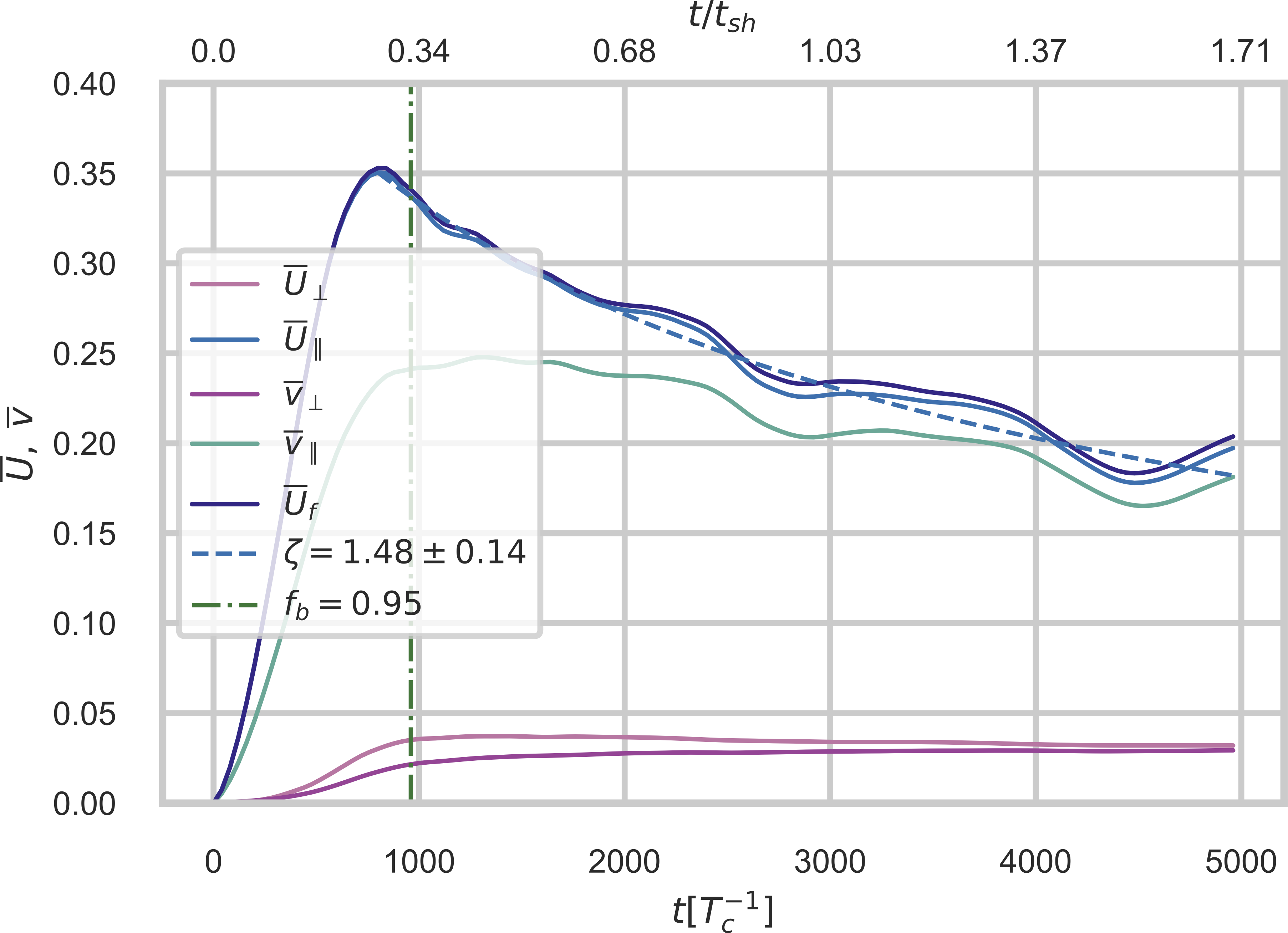
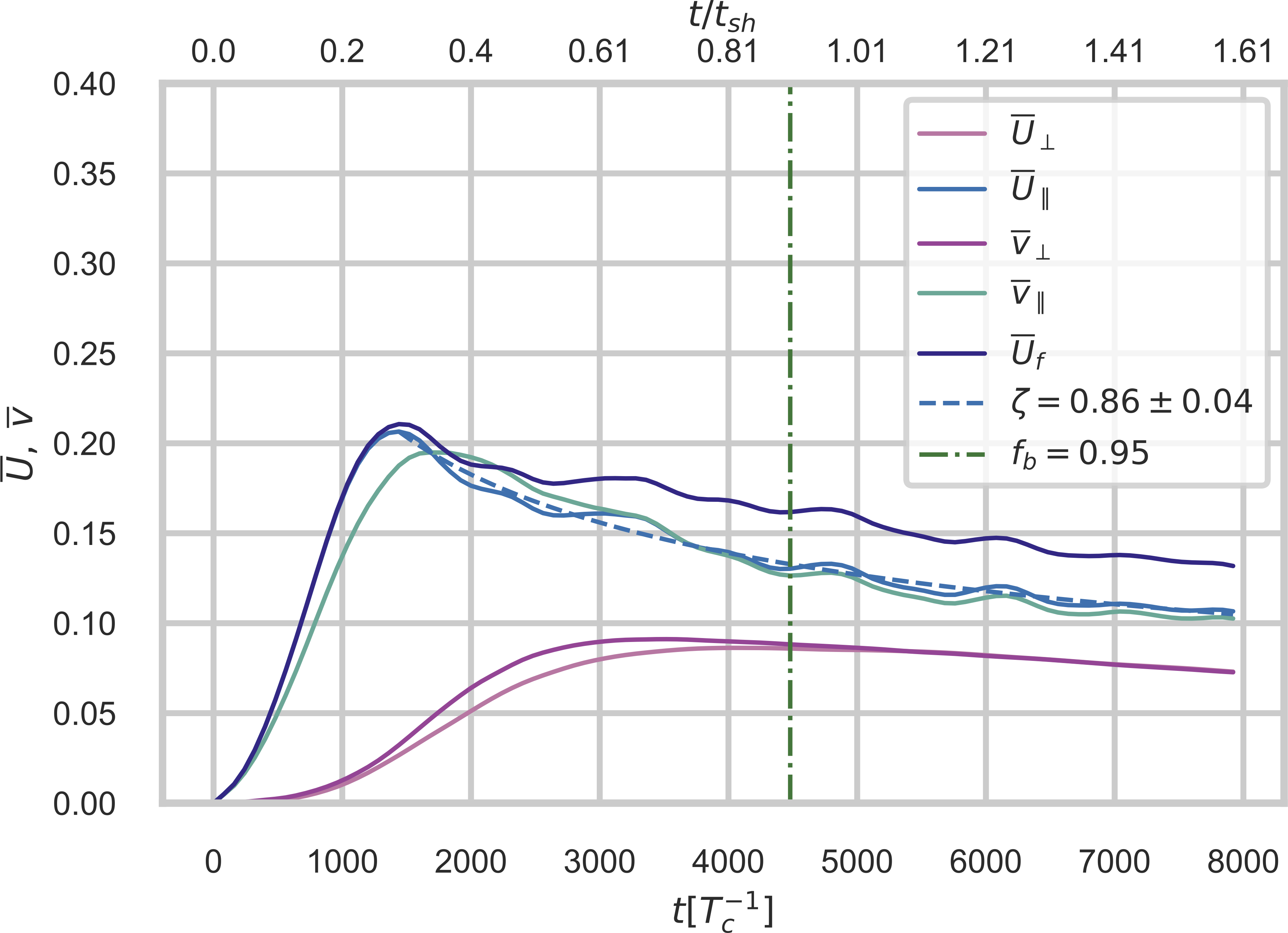
- Higgsless: $\zeta \approx 10/7$ for deflagrations too 2409.03651
- Could metastable phase heating be responsible?
GW saturation
Asymptotic $\Omega_\text{gw}(t) = \Omega_\text{gw}^\infty \left[ 1- \left(\Delta t/t_*\right)^{-d}\right]$
$v_\mathrm{w} = 0.92$, $\alpha = 0.67$
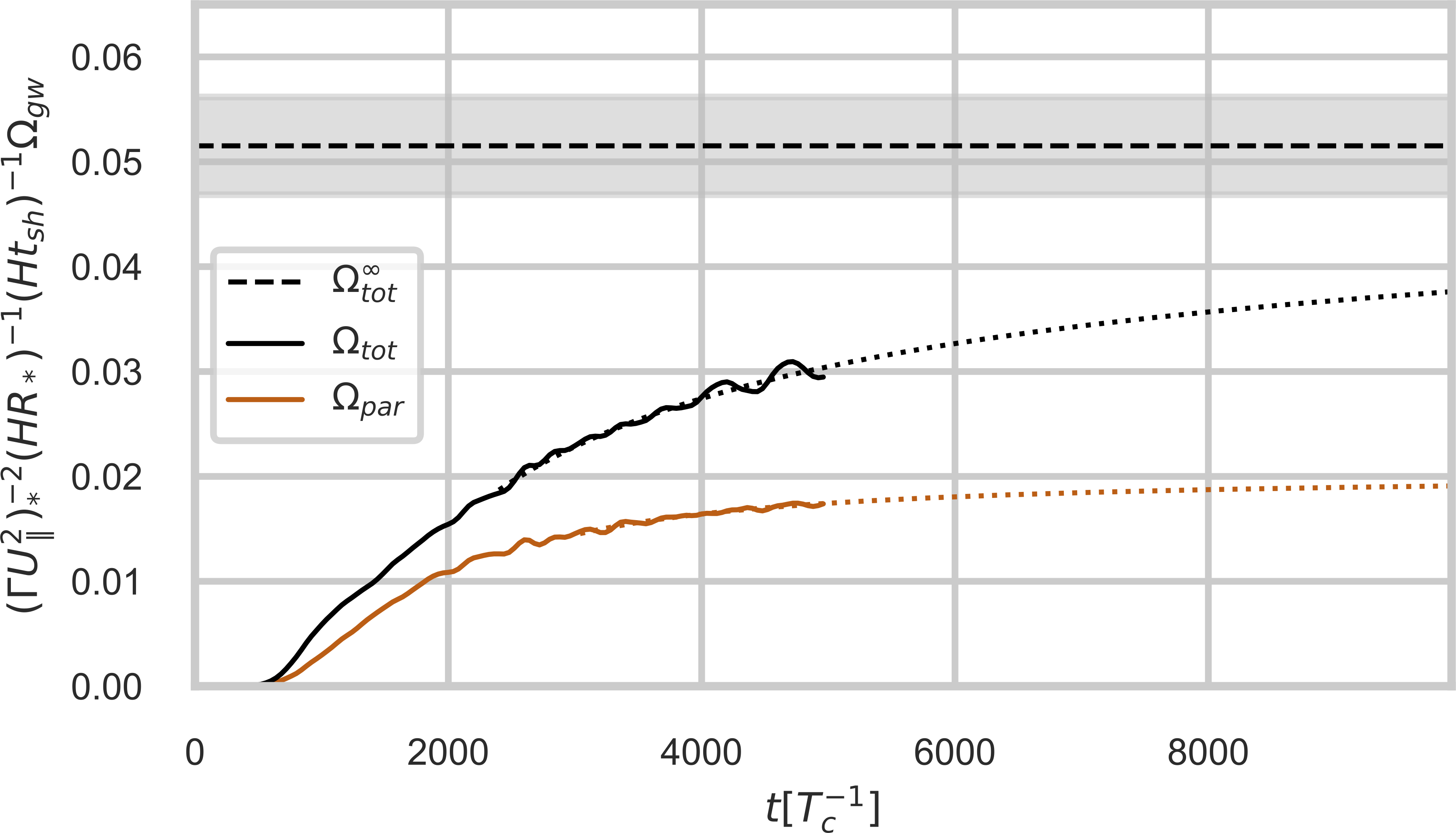
$v_\mathrm{w} = 0.44$, $\alpha = 0.5$
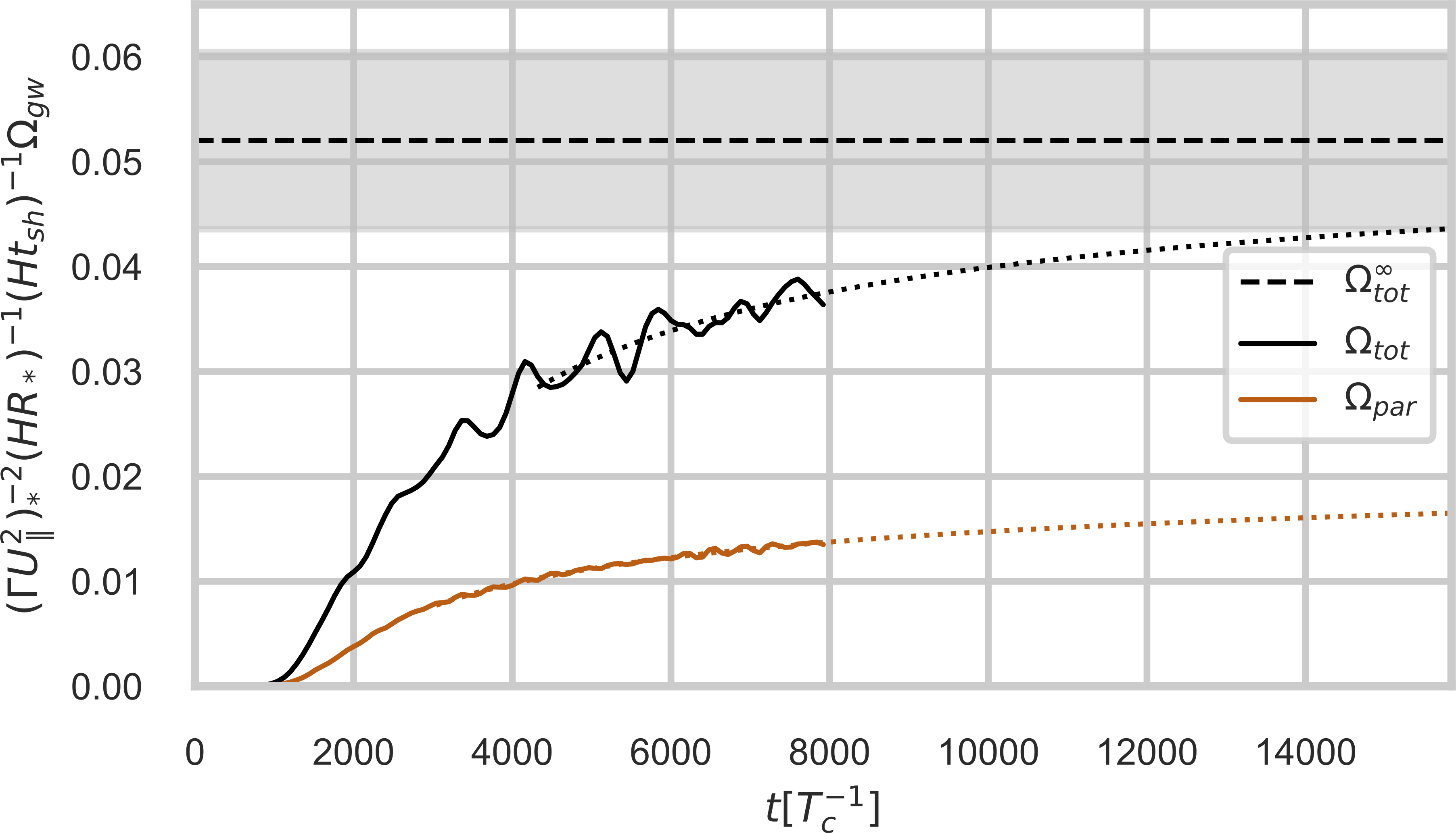
Can thus determine a dimensionless final 'efficiency' factor for GW production $\tilde{\Omega}_\text{gw}^\infty \approx 0.017$.
Next: "deep field" ➢ "wide field"
Scan in $v_\mathrm{w}$, $\alpha$, $R_*$, ... – here is a sample:
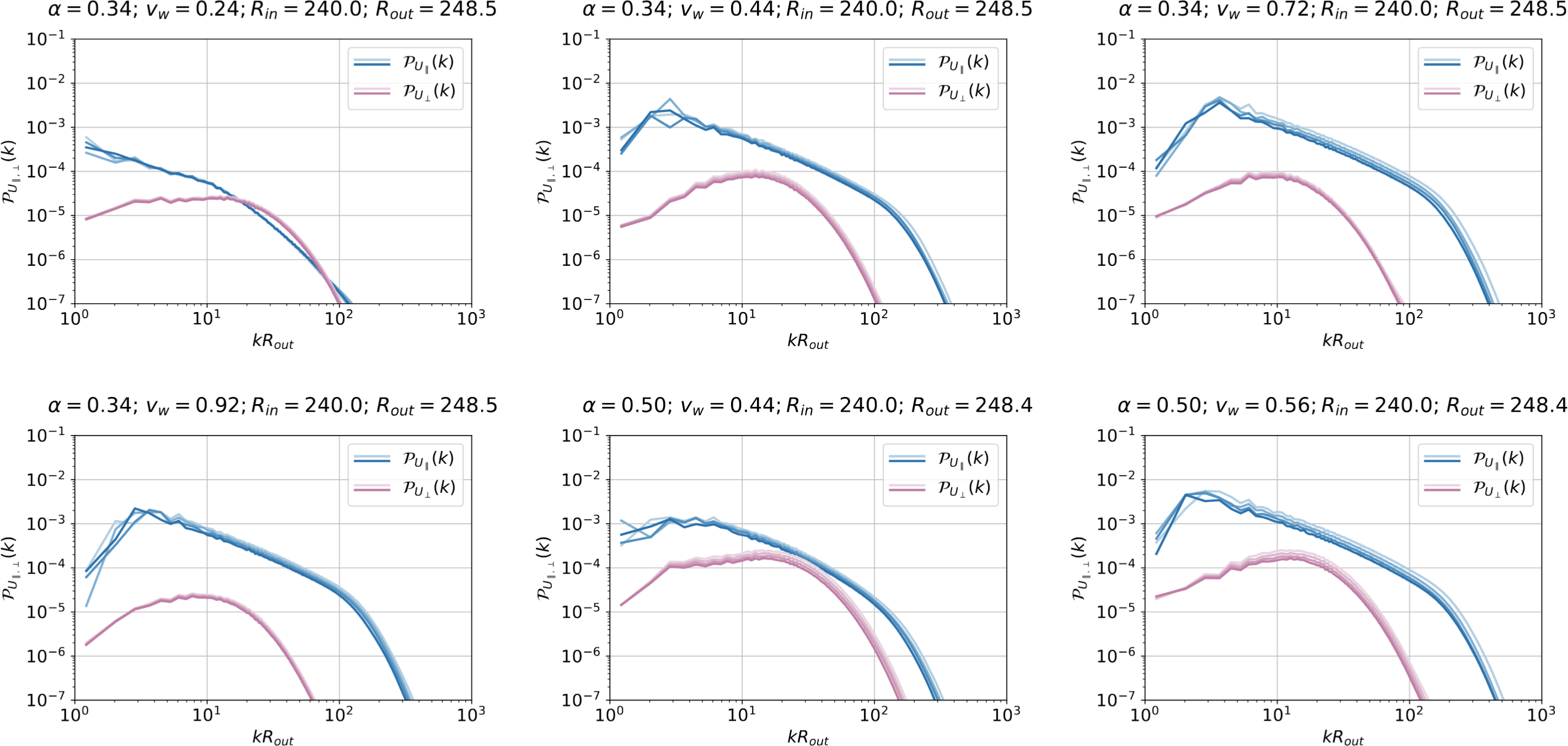
Including hybrids!
A plug
We are organising a COST action titled 'HIPPO'
(HIggs Pairs and POtential). Topics will include:
- Complementarity between collider physics and gravitational wave cosmology
- Improving the accuracy of predictions of stochastic cosmological backgrounds from BSM physics
- Providing public tools to analyse data
- Sharing expertise collider physics ⇋ GWs/cosmology (e.g. machine learning)
Interested in signing the proposal? Please email me (david.weir@helsinki.fi) by 12.00 CEST on Wed 30.9.
Conclusions
- We have extended our earlier simulation-based studies to strong phase transitions
- See evidence for turbulent motion in both compressional and longitudinal modes
- For strong phase transitions with short duration compared to Hubble damping, can extrapolate $\Omega_\text{gw}^\infty$
Questions you might like to ask me
- What phenomena might explain the discrepancies for deflagrations?
- Is there any evidence of non-Gaussianity?